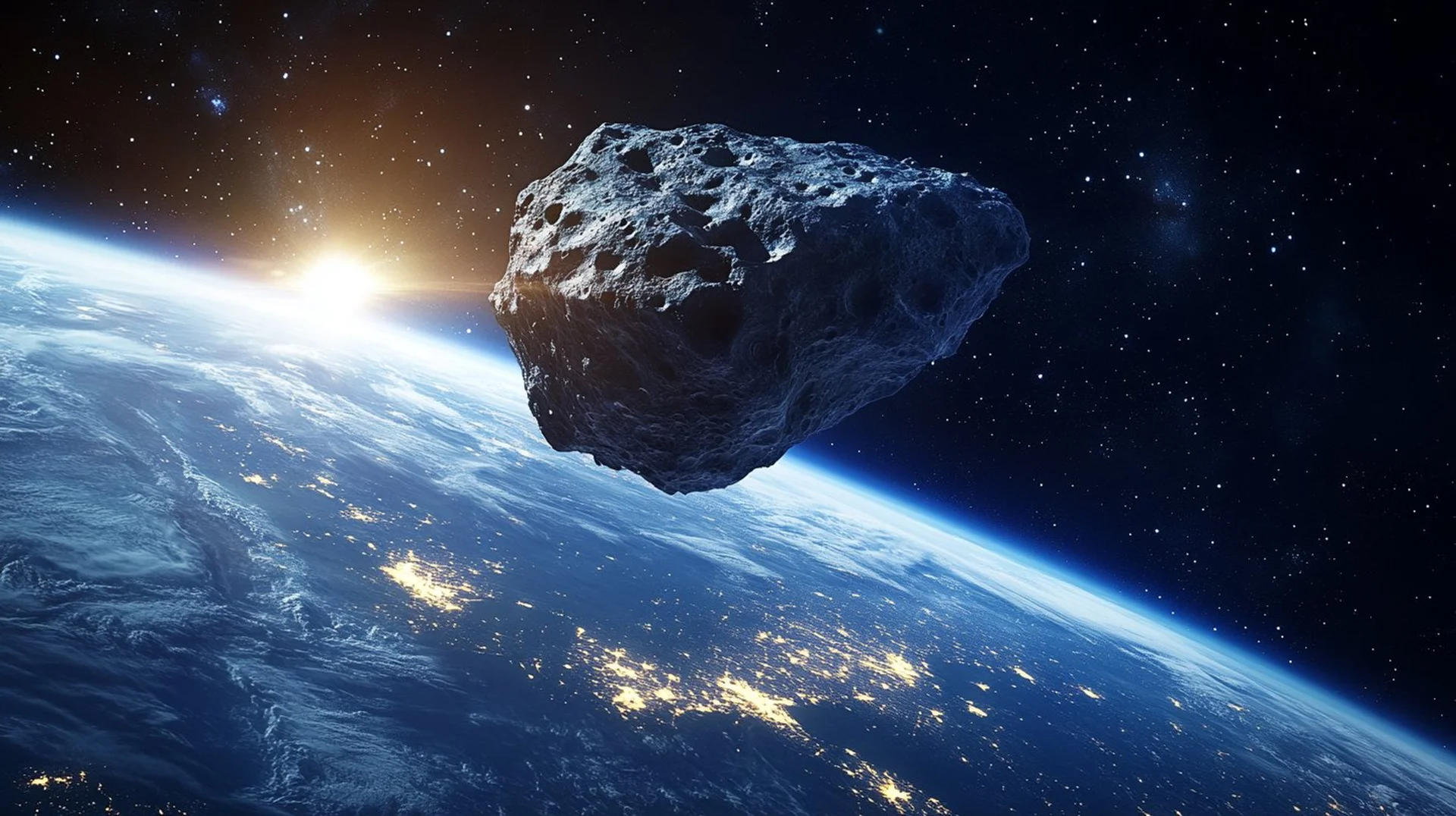
A city-sized rock briefly carried a four percent chance of hitting the moon. It won't, but the scramble to track it exposed how much of planetary defence still doesn't exist.
◆ In Summary
Asteroid 2024 YR4 will not hit the Moon in 2032, but its brief rise to a four percent impact probability served as a reminder that planetary defence remains a work in progress. The asteroid was successfully tracked and its orbit refined, yet the episode highlighted a more uncomfortable reality: thousands of potentially dangerous asteroids remain undiscovered, and no operational deflection system currently stands ready for deployment.
◆ At a Glance
| Discovered | Late 2024, ATLAS survey |
| Initial Earth probability | Up to 3.1% (December 2032) |
| Peak lunar probability | ~4% (December 2032) |
| Final status | Miss confirmed, February 2026 |
| Miss distance (Moon) | ~13,200 miles |
| Size estimate | 53 to 67 metres across |
| Observed by | James Webb Space Telescope |
| Close approach date | December 2032 |
Let us start with a number, because the number is the whole point of this. Four percent.
For a few weeks in early 2025, Asteroid 2024 YR4 carried a calculated four percent probability of striking the moon. Not our Earth. The moon. Scientists had already ruled Earth out and moved on to our nearest neighbour as the next item of concern. If that sounds like progress, you are reading it wrong.
Four percent barely registers in most contexts. The chance your flight is delayed. The probability it rains on a Bank Holiday (and we would all take a four percent chance of rain in Britain on any given day). But in planetary defence, four percent is the kind of figure that has scientists out of bed at two in the morning rechecking their calculations, and planetary defence agencies hovering somewhere between "heightened concern" and "trying not to cause a panic." Most newly found asteroids are assigned impact probabilities in fractions of a percent before better data sends the risk back to zero. A figure that holds at four percent for weeks is, by the standards of this very specific and frankly underappreciated field, properly alarming.
What Was Asteroid 2024 YR4?
Chile's ATLAS station found it. That is what ATLAS does. It hunts. In late 2024 it found 2024 YR4, and by early 2025 nobody liked what the numbers were saying. A real probability of hitting Earth. 22 December 2032. Written down in the data like it was nothing. More observations came in. The probability fell. Then it vanished entirely. At which point, attention shifted to the moon because the moon was still in the frame. Which is a bit of a strange thing to type. But there it is.
Why Did Scientists Think 2024 YR4 Might Hit the Moon?
Here is the part most coverage skipped. Newly discovered asteroids do not arrive with a confirmed destination. What you get instead is a cloud of possible future positions, and that cloud shrinks as more observations come in. More data, sharper picture. The cloud can straddle both Earth and moon at different points in the calculation, which is exactly what happened here. 2024 YR4 moved through several of these possibilities before the picture finally resolved.
How NASA Ruled Out an Impact
In February 2026, observations from the James Webb Space Telescope settled it. Pointed at an object this small, at that distance, the observations were pushing the instrument hard. What came back left no room for argument: 2024 YR4 will miss the moon by roughly 13,200 miles in December 2032. Not a graze. A clean pass. The threat, such as it was, is gone.
So. Fine. Everyone can relax.
Except the story does not end there. Not even close.
What 2024 YR4 Revealed About Planetary Defence
The editorial opinion you will not find in the official press releases is this: we got away with it, and we should be honest about that.
What the episode actually exposed is how much of our planetary defence capability exists on paper rather than on a launchpad. Nancy Chabot of Johns Hopkins University Applied Physics Laboratory was direct about it in February 2026. No spacecraft is currently sitting around, fuelled and ready, waiting for a confirmed threat. The DART mission in 2022 proved the deflection concept works. A controlled trial with a rock that posed no threat to anyone. The results were genuinely impressive. But DART was the beta test. Nobody built the operational system that was supposed to follow it (NASA has been asking Congress for the funding to do so for years; Congress has, predictably, had other priorities).
What Happens If We Discover a Real Threat?
The physics is not the problem. Push an asteroid by even a few centimetres per second early enough in its journey and it drifts wide of Earth across the years that follow. The gap between a hit and a miss, measured that far out, is surprisingly cheap to manufacture. What is not cheap, or fast, or simple, is detecting the object in the first place and then mobilising a response before the window closes.
How Many Dangerous Asteroids Are Still Missing?
On 14 February 2026, at the American Association for the Advancement of Science annual meeting in Phoenix, Dr. Kelly Fast, NASA's acting planetary defence officer, said that approximately 15,000 asteroids large enough to destroy a city remain undetected. City-killers. Just out there, untracked, unknown. She did not dress it up. "It keeps me up at night," she told the conference. That is not a figure of speech from someone in her position. It is a professional assessment.
We have catalogued roughly 40 percent of the near-Earth asteroids capable of civilisation-level damage. The rest are driving alongside us in the dark.
2024 YR4 sits on the smaller end of worrying, somewhere between 53 and 67 metres across, enough to cause catastrophic regional destruction but not the kind of object that ends civilisations. The city-killers Fast actually loses sleep over are considerably larger and considerably harder to shift. And the timeline problem cuts both ways. Eight years of warning, which is roughly what 2024 YR4 offered at its scariest, sounds workable until you price in spacecraft construction, testing and the narrow windows available for an intercept mission. Everything has to go right, immediately, with no delays. The history of large international science programmes does not suggest that is a reasonable thing to assume.
There is a long human tradition of treating close celestial calls as messages. Cultures across every continent read comets and near-misses as signals, not the threat itself, but the sky insisting that attention be paid. The near-miss was the communication. Nothing happening was not evidence that nothing was being said. It was evidence the message got through in time.
Whether that framework means anything to you is your call. What is harder to dismiss is the practical version of the same idea. 2024 YR4 arrived, was tracked, kept the numbers uncertain for long enough to be genuinely unsettling, and then resolved. In that window, every limitation in the current planetary defence system became visible to anyone paying attention.
The statistical frequency of a serious asteroid strike is reassuring on paper. Once every 20,000 years for an object of significant scale sounds like comfortable odds. The catch is that comfortable odds are only useful if the infrastructure exists to act when they finally turn against you. Right now, it does not. The 2027 International Asteroid Warning Network drill, a global simulation testing detection, tracking and government alert chains, assumes the threat has already been found. Given that 15,000 city-killers are currently going about their business unobserved, that assumption is doing a lot of heavy lifting.
Why 2024 YR4 Still Matters
2024 YR4 is gone. The lesson it delivered is not.
The ancient sky-watchers were right about one thing: the sky is absolutely worth watching carefully. They just had the mechanism wrong. It is not divine communication. It is orbital mechanics. The difference, right now, feels smaller than it probably should.
In July 2026, the Webb observations that closed the book on 2024 YR4 were published as a peer-reviewed paper, and the detail that stands out is not really about this asteroid at all. It was the faintest near-Earth object ever detected by any instrument. That is the quiet headline. The telescope built to look at the edge of the observable universe just proved it can also do the unglamorous, close-to-home work of planetary defence, and rather well.
Frequently Asked Questions
What is asteroid 2024 YR4?
2024 YR4 is a near-Earth asteroid discovered by the ATLAS survey in late 2024. Early observations briefly suggested a small chance of impact with Earth and later the Moon in 2032.
Did asteroid 2024 YR4 almost hit Earth?
For a short period in early calculations, 2024 YR4 appeared to have a small probability of impacting Earth in December 2032. Additional observations ruled out an Earth impact entirely.
Did asteroid 2024 YR4 almost hit the Moon?
Yes. After Earth was ruled out, scientists calculated a temporary chance of impact with the Moon. Follow-up observations from the James Webb Space Telescope later confirmed that the asteroid will miss by around 13,200 miles.
How big is asteroid 2024 YR4?
Refined infrared measurements from the James Webb Space Telescope now put 2024 YR4 at roughly 53 to 67 metres across, tighter than earlier visible-light estimates. An object of this size could cause severe regional damage if it struck Earth but would not be an extinction-level threat.
What is planetary defence?
Planetary defence is the effort to detect, track and potentially deflect asteroids that could threaten Earth. NASA, ESA and other agencies monitor near-Earth objects continuously.
Could NASA stop an asteroid from hitting Earth?
NASA demonstrated asteroid deflection technology with the DART mission in 2022. However, there is currently no fully operational planetary defence system ready to launch immediately in response to a confirmed threat.
What did asteroid 2024 YR4 teach us?
The episode highlighted both the strengths and weaknesses of modern planetary defence. Scientists successfully tracked the object and ruled out a collision, but it also exposed gaps in detection capabilities and emergency response planning.
How many dangerous asteroids remain undiscovered?
NASA estimates that thousands of potentially hazardous asteroids remain undetected, including around 15,000 objects large enough to destroy a city if they struck Earth.
◆ Also In The Stars

◆ Go Deeper
Recommended
Affiliate links — we may earn a small commission at no cost to you.