The first human mission to Mars is no longer a question of imagination. It is a question of radiation, fuel, politics and whether anyone can solve them fast enough.
◆ In Summary
Humans will land on Mars eventually. The engineering challenges are severe but not impossible. The political and financial obstacles are at least as significant. The evidence points to the late 2030s at the earliest, and that assumes a sequence of things going right that rarely do. The promotional timelines tend to skip past the radiation problem. They probably should not.
◆ At a Glance
| Closest approach | 33 million miles |
| Furthest approach | 249 million miles |
| One-way transit | 6 to 9 months |
| Full round trip | 500 to 900 days |
| Transfer window | Every 26 months |
| SpaceX target | 2029 (revised repeatedly) |
| NASA target | "As early as the 2030s" |
| STPI assessment | Earliest 2037, realistic 2039 |
Why Did SpaceX Delay Its Mars Plans?
In February 2026, Elon Musk announced that SpaceX was shelving its Mars ambitions for five to seven years. The moon was the new priority, he said. Lunar launches are possible every ten days, which means you can iterate, fail, and try again at a pace Mars simply does not allow. The transfer window comes around once every 26 months and if you miss it, that is two years gone.
The timing is worth noting. The 2026 Mars transfer window was closing. Orbital refuelling between two separate Starships had not been demonstrated at scale, and without it no Mars mission is physically possible. Musk had rated the 2026 window at fifty-fifty as recently as May 2025, which is the kind of odds that should probably have triggered more alarm than it did.
By December he was publicly calling the Mars mission "a distraction." This from the man who had previously dismissed the moon in exactly the same terms. The moon pivot is partly genuine strategy. It is also a more defensible exit from a promise the engineering had already made untenable. This was, for the record, the same Elon Musk who predicted a Mars landing by 2022. When 2022 passed without incident he moved it to 2024, then to 2029. Each revision arrived with the same confidence as the one before it.
When Will Humans Land on Mars? What NASA Says
NASA's position is more measured and considerably less specific. Humans to Mars "as early as the 2030s" has appeared in NASA documentation for the better part of a decade. The 2030s, in that phrase, have always been conveniently far enough away to avoid immediate scrutiny. An independent assessment commissioned by Congress and published by the Science and Technology Policy Institute put the earliest feasible departure at 2037, with 2039 more realistic once you price in the budget shortfalls and testing delays that have accompanied every large NASA programme in living memory. That number is less exciting than the press releases. It is probably more accurate.
How Far Away Is Mars, and Why Does That Matter?
The distance is the first problem, and it is a bigger one than the press coverage usually suggests. At its closest Mars is 33 million miles away; at its furthest, 249 million. The gap shifts constantly as both planets move through their orbits, which is why the transfer window matters so much. A one-way trip takes six to nine months. The crew spend that time exposed to galactic cosmic radiation at levels no spacecraft currently in existence is designed to handle over that duration. The round trip, including surface time, runs to somewhere between 500 and 900 days. Nobody has spent that long in space. The record for a single continuous spaceflight is 437 days, set by Valery Polyakov on Mir in 1995, in a station with considerably more room than anything proposed for a Mars transit vehicle.
What Is the Radiation Problem on a Mars Mission?
Radiation is not a solvable problem with current technology. A Mars crew would absorb doses exceeding current career limits for astronauts by a significant margin. The cancer risk alone is substantial enough that NASA has had internal debates about whether acceptable risk thresholds can even apply to a Mars mission. Progress on shielding has been real. A solution has not arrived.
Is the SpaceX Starship Architecture Ready for Mars?
SpaceX's plan centres on Starship, which has made remarkable progress since its early explosive test flights. The architecture requires launching multiple Starship tankers into Earth orbit, transferring around 1,200 tonnes of propellant to the crewed vehicle, then landing the whole assembly on the Martian surface. To understand what that means in practice: in November 2024, SpaceX transferred five metric tonnes of propellant between two tanks on the same vehicle. They called it a milestone, and it was. The Mars mission needs 1,200 tonnes moved between entirely separate spacecraft. The arithmetic is not encouraging.
A 2024 feasibility study published in Nature concluded the Starship architecture for a crewed Mars mission is currently unworkable due to several fundamental engineering challenges. The orbital refuelling problem is the most immediate. Entry, descent and landing on Mars is the one after that. The atmosphere is thin enough to make parachutes largely useless but thick enough to cause significant heating, a combination that has no simple solution. Then there is the matter of producing 2,400 tonnes of return propellant on the Martian surface using infrastructure that does not yet exist, powered by a nuclear reactor roughly 100 times more powerful than anything currently under development. These are not problems that yield to optimism or to iterative improvement on a short timeline. They require solutions that have not been found.
Why Go to the Moon Before Mars?
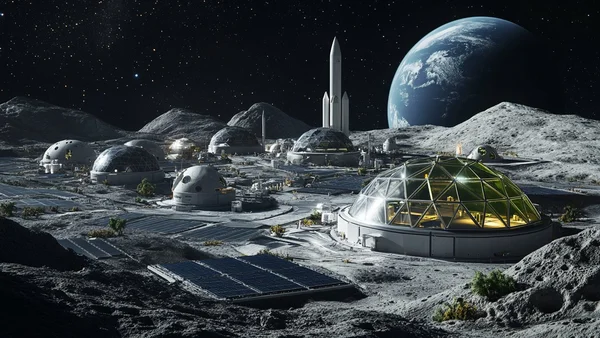
NASA's approach is more methodical and considerably less funded. The current administration's budget proposes cutting the agency's overall funding by around 25%, with science taking the heaviest hit. Mars is described as a "horizon goal." In government planning language, that means the thing you gesture toward while arguing about the thing in front of you. The thing in front of NASA right now is getting back to the moon, building a base there, and demonstrating the technologies a Mars mission would eventually require. That is the right sequence. It is also a sequence that, done properly, takes decades.
The moon-first logic is sound. Long-duration life support, in-situ resource utilisation, nuclear surface power, deep space communications: all of it needs validating somewhere closer before anyone sensibly commits a crew to a two-year round trip with no rescue option. The lunar base programme, if it proceeds on schedule and on budget, provides that proving ground. Both of those conditions are historically ambitious for a NASA programme.
So What Is the Realistic Date?
So. The honest answer.
Humans will almost certainly land on Mars eventually. The engineering challenges are severe but none of them are physically impossible, radiation included, though that one deserves more honesty than it usually gets in the promotional material. The political and financial obstacles are, in the current climate, at least as significant as the technical ones and considerably harder to model. The evidence points to the late 2030s at the earliest, and that assumes a sequence of things going right that rarely do. The lunar base programme has to stay roughly on track. Starship has to demonstrate orbital refuelling at scale. At least two consecutive US administrations have to maintain both the commitment and the budget, which is perhaps the least likely condition of the three.
Musk will probably announce a new date before this article is six months old. NASA will continue describing Mars as a horizon goal. Neither of those things changes the engineering. The 2030s are possible. The 2040s are more likely. The question of whether humans can survive the radiation exposure well enough to do useful work when they arrive is one the promotional timelines tend to skip over. It probably should not be.
Frequently Asked Questions
When will humans land on Mars?
The most credible independent assessment, from the Science and Technology Policy Institute, puts the earliest feasible crewed Mars departure at 2037, with 2039 more realistic. NASA describes Mars as a target for the 2030s. SpaceX has moved its stated date repeatedly, deprioritising Mars in favour of the moon in February 2026.
When will we go to Mars?
The late 2030s at the earliest, assuming orbital refuelling at scale is demonstrated, the lunar base programme stays roughly on track, and at least two consecutive US administrations maintain the commitment and the budget. The 2040s are considered more likely by independent analysts.
How long does it take to travel to Mars?
A one-way trip takes six to nine months depending on the launch window. The full round trip, including surface time, runs to between 500 and 900 days. The longest continuous spaceflight on record is 437 days, set by Valery Polyakov on Mir in 1995.
What is the biggest obstacle to a crewed Mars mission?
Several unsolved problems exist simultaneously: orbital propellant transfer at the scale required, entry descent and landing on Mars, producing return fuel on the Martian surface, and radiation exposure during the transit. A 2024 Nature feasibility study concluded the Starship Mars architecture as currently designed is unworkable.
How dangerous is the radiation on a Mars mission?
A Mars crew would absorb radiation doses exceeding current NASA career limits by a significant margin. The cancer risk is substantial enough that NASA has had internal debates about whether standard acceptable risk thresholds can even apply to a Mars mission. Shielding has improved but no solution has arrived.
Why did Elon Musk delay Mars plans?
In February 2026 Musk announced SpaceX was shifting focus to the moon for five to seven years. Orbital refuelling required for a Mars mission had not been demonstrated at scale. Musk had previously predicted Mars landings in 2022, then 2024, then 2029. Each revision arrived with the same confidence as the one before it.
◆ Also In The Stars
◆ Go Deeper
Recommended
Affiliate links — we may earn a small commission at no cost to you.