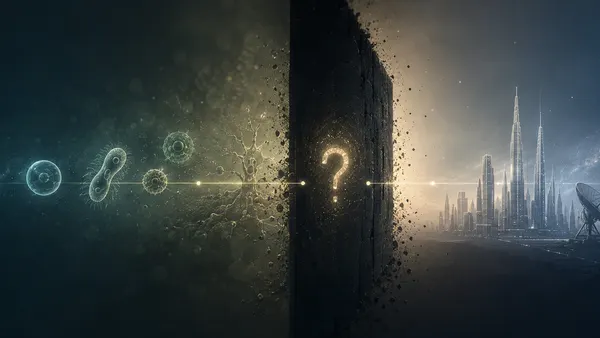
Hundreds of billions of galaxies suggest we should not be alone. Decades of searching suggest we might be. The contradiction has become one of the most unsettling questions in modern science.
◆ In Summary
The Fermi Paradox asks a simple question: if intelligent life should be common in a universe containing billions of stars and planets, why have we found no evidence of it? Proposed solutions range from the possibility that intelligent life is exceptionally rare to the idea that advanced civilisations routinely destroy themselves before spreading through the galaxy.
◆ At a Glance
| Question posed | 1950, Enrico Fermi at Los Alamos |
| SETI founded | 1960 |
| Wow! Signal detected | 1977, direction of Sagittarius |
| Wow! Signal repeated | Never |
| Great Filter coined | Robin Hanson, 1996 |
| Galaxies in observable universe | Hundreds of billions to trillions |
| SETI confirmed detections | Zero |
| James Webb role | Searching exoplanet atmospheres for biosignatures |
Are we alone? Is Earth the only outpost of life in the universe? Questions like these have bothered us for as long as we've had records, and despite all the talking, thinking and searching, we still cannot give definitive answers to them. The search continues regardless.
How can we be alone? The observable universe contains hundreds of billions to possibly trillions of galaxies, each with billions of stars and planets. The conditions and opportunities for life appear to be everywhere. The evidence for life, beyond Earth, is nonexistent. Shouldn't there be unmissable signs of civilisation writ large across the sky? Or have we just missed the signals? Perhaps we are too late to see them or too early?
The Fermi Paradox: Where Is Everybody?
In 1950, the physicist Enrico Fermi reportedly condensed this problem into a simple, single question delivered over lunch at Los Alamos to a group of friends and colleagues. He asked, semi-jokingly, 'where is everybody?' His colleagues found it funny, and the question lingered. Any humour in the question has now gone and we have spent the last seventy years looking for everybody, or indeed anybody. Either we are alone, which forces questions about why we are here that science was not designed to answer. Or we are not alone, and something is keeping everything else quiet. Either way, our existence apparently signifies something rather special.
The Great Filter
Robin Hanson noticed this and developed the 'Great Filter' hypothesis in the 1990s. He was an economist, not an astronomer, which may be why his thinking cut through in a way that purely scientific approaches had not. The argument runs like this: somewhere between dead matter and a civilisation detectable across the galaxy, there is a step so improbable that almost nothing clears it. The filter is a barrier that every growing lifeform must meet at some point, or else it never progresses to the point it can explore the stars sufficiently to be seen. The question that follows from this, and it is not a comfortable one, is whether that filter is behind us or still ahead.
If it is behind us, we may be genuinely unusual. If intelligent life is extraordinarily rare, then the eventual fate of Earth and the Sun may matter far more than we realise, because there may be very few other technological civilisations to carry life forward elsewhere in the universe. The hard part was getting here, and almost nothing else managed it. The silence makes sense.
This is the optimistic reading, and it carries an odd implication: we should hope, quite urgently, that Mars is sterile. That every probe we send to every potentially habitable world comes back empty. Because finding complex life elsewhere would mean the early steps are not the filter. Which would put it somewhere later, at the stage of technological civilisation, and the candidate mechanisms for civilisational collapse in 2026 are not exotic. Nuclear arsenals. Engineered pathogens. Climate systems pushed past recovery. Artificial intelligence outpacing the institutions meant to govern it. If this is the case, there may be countless civilisations dotted around the universe that reached where we are today but were filtered out of existence.
The Search for Signals
SETI, the ongoing scientific search for extraterrestrial intelligence, has been forlornly listening for any signs of life since 1960. In those sixty-five years of searching, the famous Wow! signal of 1977 is the most notable candidate signal. It was a radio burst from the direction of Sagittarius that matched what an interstellar transmission might look like. It caused considerable excitement at the time, but it has never been repeated and nobody knows what caused it. The James Webb Space Telescope is currently finding exoplanet atmospheres worth studying, though nothing confirmed as biological as yet. The silence holds and no one knows when that might change.
We are either alone in this universe or we are not. Both answers, considered honestly, are staggering. If we are alone, the question of why forces itself into places it does not usually get to go, into physics, into astronomy, into the kind of sober probability calculations that are supposed to be immune to existential weight. It turns out they are not. And if we are not alone, the silence needs explaining, and most of the explanations are not ones you would choose to find convincing. Fermi asked his question over lunch and then went back to work. There is not much else to do with it.
Frequently Asked Questions
What is the Fermi Paradox?
The Fermi Paradox is the apparent contradiction between the vast number of potentially habitable worlds in the universe and the complete lack of confirmed evidence for extraterrestrial civilisations.
Who was Enrico Fermi?
Enrico Fermi was an Italian-American physicist and Nobel Prize winner. He is remembered in this context for asking the famous question: "Where is everybody?"
What is the Great Filter?
The Great Filter is a hypothesis suggesting that one stage in the development of intelligent life is extraordinarily difficult, preventing most civilisations from becoming detectable across the galaxy.
What was the Wow! Signal?
The Wow! Signal was a strong radio signal detected in 1977 that briefly appeared to resemble an artificial transmission. It has never been satisfactorily explained or repeated.
Has SETI found alien life?
No. Despite decades of searching, SETI has not detected any confirmed signals from extraterrestrial civilisations.
Are we alone in the universe?
Nobody knows. Despite decades of searching, scientists have found no confirmed evidence of extraterrestrial life. The Fermi Paradox exists because many researchers believe intelligent life should be common, yet the universe appears silent.
◆ Also In The Stars



◆ Go Deeper
Recommended
Affiliate links — we may earn a small commission at no cost to you.