A man who spent thirty years inside the sanctuary still couldn't say for certain what was actually happening to the woman on the tripod.
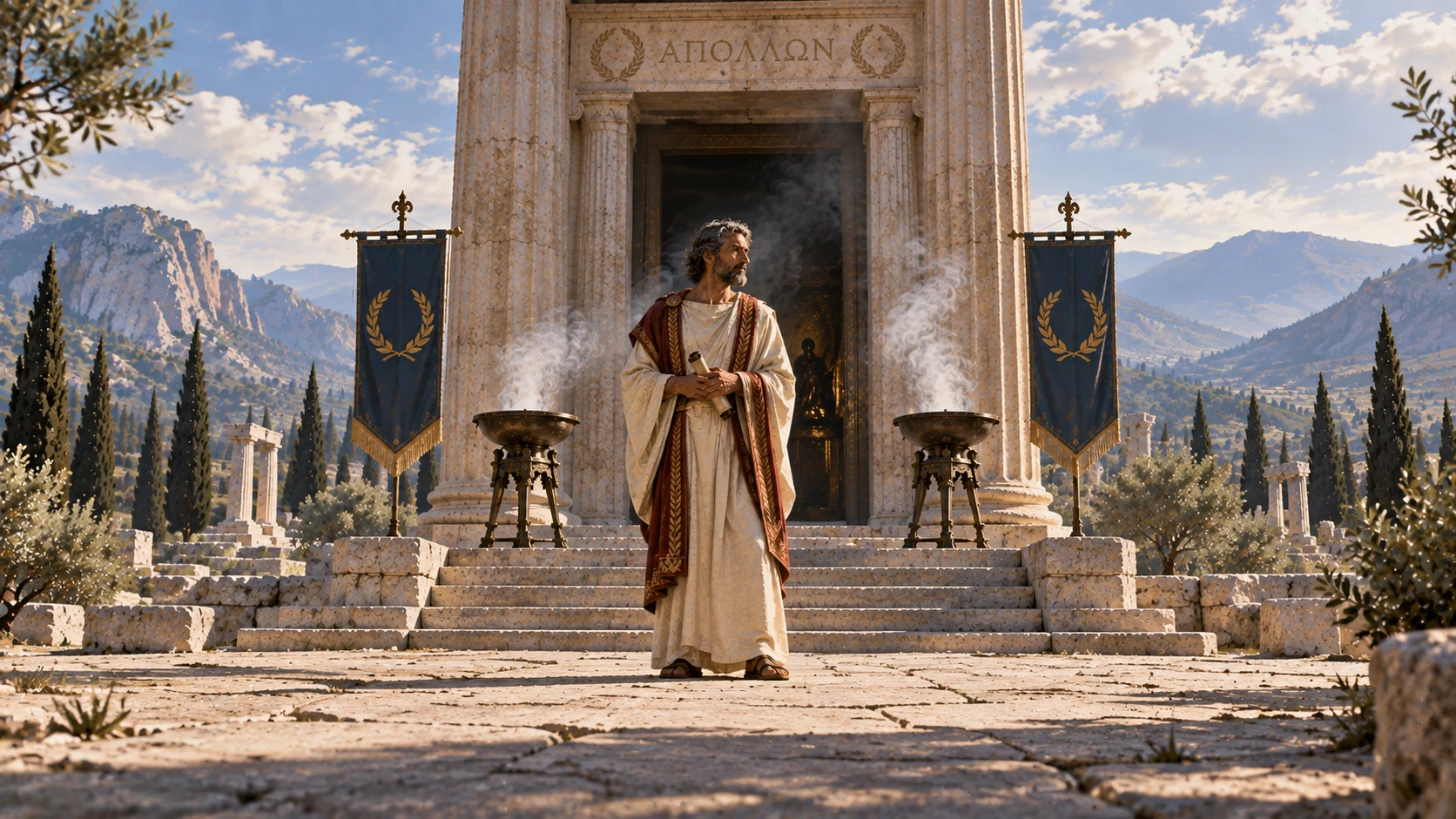
Plutarch and the Oracle of Delphi: A Priest's Account
◆ In Summary
Plutarch spent the last three decades of his life as a priest at Delphi, and left behind two dialogues exploring how the Oracle actually functioned. His writings describe a pneuma, a prophetic vapor, rising from the earth and affecting the Pythia's body, though his characters argue among themselves about what that really meant. One account describes a Pythia forced into a consultation against an unfavourable sign, who died within days. Modern geology has found evidence of hydrocarbon gases at the site, but scientists still dispute whether there was ever enough to explain a trance. Even a man who lived inside the sanctuary for thirty years couldn't say for certain what was actually happening.
As regular readers will know, I've already covered the Delphic Oracle and the Pythia in a couple of articles I've written on the site. Prophecy in the ancient world is a topic I find fascinating, from the blind Theban seer Tiresias to the Pythia, and I was keen to explore further through Plutarch’s writings on the subject.
I'm sure many of you will have heard of Plutarch (I'm not talking about the one in The Hunger Games). He was a philosopher and biographer from Chaeronea in Greece, living in the first and early second centuries AD.
Probably his most famous work is Parallel Lives, where he explores the characters of famous Greek and Roman men such as Alexander the Great and Julius Caesar. The Moralia is another, offering a collection of essays and dialogues covering subjects including philosophy, religion and ethics.
Of particular interest for this article, he served as one of two priests at the Temple of Apollo at Delphi for the last three decades of his life and wrote about the sanctuary and its Oracle.
Plutarch and the Oracle of Delphi
While there are many ancient sources describing events at the Delphic Oracle, Plutarch is particularly useful because of his inside knowledge of how the sanctuary operated.
Two of his dialogues, namely De Pythiae Oraculis (On the Oracles of the Pythia) and De Defectu Oraculorum (On the Obsolescence of Oracles), present philosophical conversations between a number of learned Greeks about the Oracle and the way it works. They explore how prophecy is delivered and question why the power of oracles appeared to be declining.
De Pythiae Oraculis mostly focuses on the nature and form of the Pythia's responses and explores why they were no longer delivered in verse. Its characters, including Diogenianus, Sarapion, Boethus and Theon, debate whether such changes reflect a decline from the Oracle's former grandeur. Diogenianus even questions the literary quality of some of the surviving verse oracles.
De Defectu Oraculorum takes a broader look at the tradition of oracles across Greece and questions why they are falling silent. Its characters, including Cleombrotus, Demetrius, Ammonius and Lamprias, debate several possibilities for this. They wonder if a decline in population might have led to less demand for oracles. Perhaps, they ponder, the daimones, divine or spiritual beings believed to act as intermediaries between gods and humans and associated with the various oracles, have simply disappeared or died. The third possibility suggests that the physical or natural conditions that allow the Oracle to function could also weaken or disappear.
How Reliable Are Plutarch's Dialogues?
A word of caution before we continue. These writings should not be taken as straightforward witness statements. While Plutarch often uses real people in his essays, he is ultimately constructing literary dialogues, not transcribing real conversations.
Also, we can't just assume that every statement made in the dialogues represents Plutarch's own views.
However, thanks to his long association with Delphi, there's no doubt that the dialogues provide a rare insight into how those closely connected with the sanctuary understood and debated the workings of the Oracle.
What Did Plutarch Say Caused the Pythia's Trance?
One of the aspects of the Delphic Oracle that I find most fascinating is the question of how the prophecies were actually produced.
We know that the Pythia (the high priestess of the Temple of Apollo) would enter an inner chamber at the heart of the temple, known as the adyton. Here, while sitting on a tripod, she would enter some kind of altered state which would enable her to deliver Apollo's responses to the questions put to her by consultants.
To this day, the cause of this altered state is not well understood. In his writings about the Pythia's prophetic state, Plutarch refers to a pneuma, a word that can be translated as breath, vapour or exhalation.
So what exactly is this pneuma? In De Defectu Oraculorum, Lamprias (Plutarch's brother and the narrator of the dialogue) describes what he calls a prophetic current or breath that comes from the earth.
He then claims that the earth gives off many different kinds of influences. Some of them can be harmful, others beneficial. The one that affects the Pythia, the pneuma, causes changes in her body that then make the prophecies possible. Lamprias believed that these various influences could be carried through the air or through water.
Continuing his musings, Lamprias mentions that the area where people consulting the Oracle waited was sometimes filled with a pleasant fragrance.
He says the scent is similar to an expensive perfume, adding that it appears to be carried from the adyton by air currents. Lamprias supports his account by claiming that other visitors to the temple and those working there have described the fragrance too.
Lamprias seems to believe that the pneuma was inconsistent. One day it could be strong, the next weaker. It could even disappear, perhaps explaining why oracles aren't as prevalent as they used to be.
Another character, Ammonius, pushes back on Lamprias's assertions. He basically asks what the point of the Pythia is if the pneuma itself can produce prophetic inspiration. Wouldn't it similarly affect other people exposed to it? He adds that, by the same logic, the rituals surrounding the prophecies, such as sacrifices and seeking favourable signs, are also redundant.
Lamprias responds by saying that Apollo, or indeed the gods more generally, remain the ultimate source of prophecy. The existence of a natural process like the pneuma doesn't make divinity redundant. He likens the pneuma to an instrument, the means by which divinity operates.
The Pythia, he argues, is particularly receptive to the pneuma because of her physical and psychological disposition. But even the Pythia is subject to bodily changes, meaning her receptiveness isn't constant, thus explaining why it is necessary to check her condition before each consultation.
The Death of a Pythia
As evidence of this claim, Lamprias tells the story of the time when a foreign delegation came to consult the Oracle. Apparently, the sacrificial goat didn't respond appropriately when cold water was poured over it. This was considered a bad omen, as the priests were looking for the animal to shiver, which would indicate a favourable response. Rather than desisting, the priests continued to drench the poor animal until it eventually gave the desired response.
So, despite the unfavourable sign, the Pythia was made to proceed with the consultation, even though she was reluctant. When she entered the prophetic state, she behaved in a violent and abnormal way, showing that her physical condition was an important part of the process.
She fled the chamber in distress and died a few days later.
Does Science Support Plutarch's Pneuma?
The pneuma is an interesting explanation for the prophecies. Many centuries later, scholars were sceptical of the whole idea, however. Early archaeological excavation of the site failed to uncover the fissures that would be needed to explain such a vapour.
But, as techniques improved, later surveys identified faults running beneath the sanctuary. Jelle de Boer, John Hale and other researchers found evidence of light hydrocarbon gases, including traces of ethylene. Interestingly, ethylene has a sweet smell.
On top of that, the gas can also have anaesthetic effects and produce altered states at certain concentrations.
This might seem like a slam dunk for the ethylene theory. But other scholars have questioned whether enough ethylene could ever have accumulated inside the temple to produce the effects claimed. Jay Foster and Daryn Lehoux argued that the concentrations found by de Boer et al. were not enough to explain the altered state of the Pythia. To put it in context, they claimed the ethylene concentration found at the site was roughly equivalent to what someone breathes in while standing in urban traffic today. Further to this point, Lehoux highlighted other research questioning whether the geological processes at Delphi could even produce ethylene in the quantities required.
De Boer and his colleagues argued in response that it is impossible to measure the concentration of the gas nearly two thousand years ago. There may have been enough at that time to explain the altered state of the Pythia.
Ethylene wasn't the only gas found at the site. Methane and ethane were also present, and this somewhat complicates the ethylene theory. A mixture of gases makes it much harder to pinpoint which gas could actually have affected the Pythia. Other researchers have proposed different explanations. Giuseppe Etiope and his colleagues suggested that carbon dioxide and methane could have reduced the amount of oxygen available inside the temple, potentially contributing to the Pythia's altered state.
Whatever gases may have been present, it's fair to say that geology could have played a part in the Pythia's process. In turn, this does give some credence to the idea of Plutarch's pneuma. Whether it actually affected the prophecy is, of course, another matter.
Did the Pythia Need a Gas at All?
We know that there were other aspects of the prophetic process that played an important role. As we see in religious rituals today, altered states don't always require chemical explanations. Fasting, repetitive actions and rhythmic activity can all contribute to altered states of consciousness.
Lamprias, for his part, wasn't concerned with proving that the pneuma was the sole explanation for prophecy. He, and perhaps Plutarch too, saw it as part of the process, with each element integral to the working of the Oracle at Delphi.
As I write this today, we are ultimately none the wiser as to the actual cause of the Pythia's altered state. Geology could be a major factor, or play no part at all. I find it interesting that Plutarch himself was grappling with the very same question nearly two thousand years ago. Even though he was a priest there for thirty-odd years and closely involved with the sanctuary, he still didn't know precisely what was going on.
Frequently Asked Questions
What did Plutarch write about the Oracle of Delphi?
He served as a priest at the Temple of Apollo for roughly thirty years and wrote two dialogues, De Pythiae Oraculis and De Defectu Oraculorum, exploring how the Oracle worked and why its power seemed to be declining.
What is the pneuma Plutarch describes?
A prophetic current or vapor he says rose from the earth and affected the Pythia's body, enabling her altered state. His character Lamprias describes it as sweet-smelling and inconsistent in strength.
Does science support Plutarch's account?
Partly. Geologists have found evidence of hydrocarbon gases, including traces of ethylene, at the site, but other researchers argue the concentrations found are far too low to explain a trance, comparable to standing in ordinary traffic.
Did a Pythia really die from the trance?
Plutarch records an account of a Pythia forced into a consultation against an unfavourable sign, who reacted violently and died within days, an unusually dramatic exception to what he describes as the normal experience.
◆ Also In The Stars


◆ Go Deeper
Perseus Digital Library's full English translation of De Defectu Oraculorum.↗ Bryn Mawr Classical Review's write-up of Elsa Giovanna Simonetti's A Perfect Medium? Oracular Divination in the Thought of Plutarch.↗ Foster and Lehoux's published challenge to the ethylene theory, with the actual concentration figures compared to everyday exposure.↗