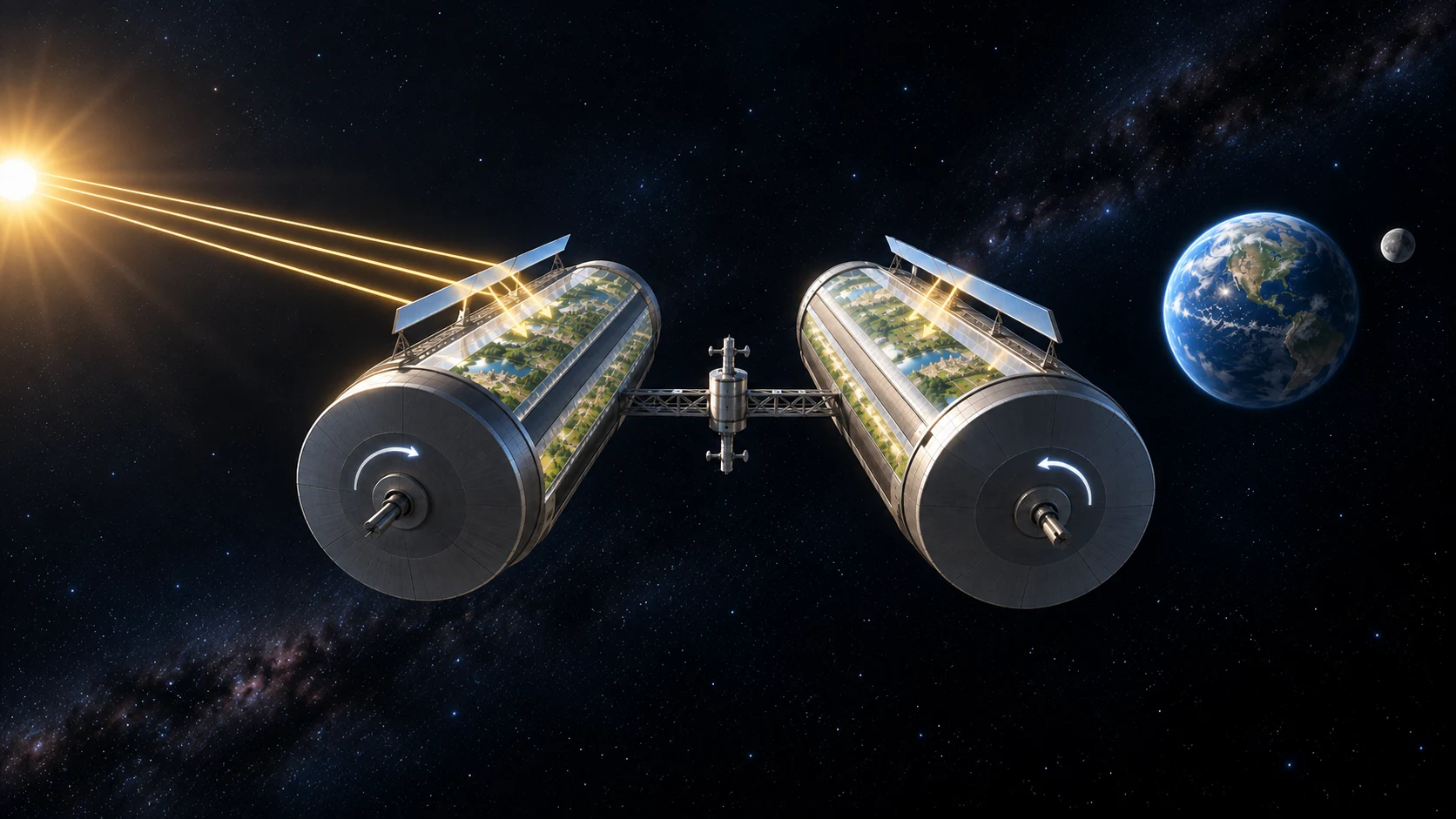
Two enormous cylinders, spinning in opposite directions, four miles wide and up to twenty long, housing millions of people under an artificial sky. That's the space colony physicist Gerard O'Neill proposed back in 1974.
◆ In Summary
Gerard O'Neill's students concluded in 1969 that planets were the wrong place for an expanding civilisation. His answer was a pair of enormous rotating cylinders, built from lunar material at the L4 or L5 Lagrange point. NASA took the idea seriously enough to run its own study in 1975, and chose a different shape, the Stanford Torus, instead. The physics holds up; the cost and the missing infrastructure are what have kept it unbuilt for fifty years. Jeff Bezos now cites it as Blue Origin's long-term vision, though Elon Musk isn't convinced.
The Paper Nobody Wanted to Publish
Gerard Kitchen O'Neill was not having much luck. Despite his best efforts, his paper "The Colonization of Space" was not proving popular.
For four years he had been approaching publications such as Scientific American and Science magazine among others. All had rejected it.
These setbacks didn't defeat him. He was determined to have it published in a serious scientific publication rather than a science fiction magazine. He wanted his idea to be taken seriously.
Finally, he struck lucky. In September 1974, Physics Today, the membership magazine of the American Institute of Physics published his paper. Perhaps now his idea would start a debate the way he had hoped?
How It All Started: A 1969 Princeton Seminar
Rewind to 1969 and Princeton University. O'Neill was teaching the standard introductory physics course and his class for that year totalled around 320 students. He'd also undertaken to take some of the same students in a small class to enable closer teaching. He wanted to see the course "from the top and the bottom at the same time."
Unfortunately, these bright young minds weren't all as keen to learn as O'Neill was to teach. The Vietnam war was a constant backdrop to American life at the time and the students had become cynical about whether science was actually beneficial to humanity.
O'Neill wasn't a man to let this pass without remedy. He started to try and make his course more engaging and interesting and cleverly used the Apollo missions as a point of reference. He knew the students were watching the events unfold on television and he posed them physics problems based on what they had seen in space.
For some of the more engaged students, O'Neill offered an extra seminar, where he posed another problem, the one that would ultimately be published five years later.
The question that O'Neill posed was this: "Is the surface of a planet really the right place for an expanding technological civilization?" He meant it to be slightly humorous to begin with, but as the weeks passed it became a more serious endeavour as the idea crystallised.
As the students began their research, they started to question their assumption that the Earth (or indeed any planet) was the only sensible place for a civilisation to live. At the time, this was a very novel approach. O'Neill himself described the fixed idea of planets as colony sites as a mental 'hangup'.
The students concluded that the answer to the question was no. So, if the surface of the Earth isn't the right place for an expanding civilization, where is? In O'Neill's words, the answer was to treat 'the region beyond Earth not as a void but as a culture medium, rich in matter and energy.'
Large habitats could be created in such a place, making use of lunar and asteroidal material perhaps, while gaining almost unlimited energy from the Sun's rays.
At this time, alongside the continuing Vietnam War worries, some Americans were becoming concerned with environmental matters and the limits of continued economic and population growth. In 1972, the Club of Rome, an international think tank, published The Limits to Growth, an influential study produced by a team at MIT that modelled how unchecked growth could eventually collide with the Earth's finite resources and environmental limits.
O'Neill realised that the idea he and his students had developed might actually offer a way for humanity to sidestep such a fate.
What Is an O'Neill Cylinder?
The idea O'Neill and his students first worked through eventually led to his most famous habitat design: a pair of enormous counter-rotating cylinders, each roughly four miles in diameter and, depending on the source, somewhere between 16 and 20 miles long (O'Neill's original 1974 paper specified 16 miles; later accounts commonly cite 20). Humans would live within each cylinder and the colony could potentially accommodate millions. O'Neill would later call this version of the idea Island 3 in his 1976 book The High Frontier: Human Colonies in Space.
The cylinders would rotate, providing gravity akin to Earth's. It would be strongest near the walls of the cylinder, which would behave as the ground on Earth. The gravity would weaken towards the centre of the cylinders, where it would be a zero-g zone. The two cylinders would rotate in opposite directions, cancelling their net axial angular momentum and making it easier to keep their axes pointed towards the Sun, giving the inhabitants a continuous source of solar energy.
The two cylinders would be built at a Lagrange point, specifically the L4 or L5 position in the Earth-Moon system. Here, the assembly would take place and once completed the colony could remain in this relatively stable region. The raw materials required for building would be sent via a mass driver (an electromagnetic launcher on the Moon's or an asteroid's surface) to the Lagrange point, reducing the need for rockets during this stage. O'Neill later told Congress that Earth sits at the bottom of a gravitational well "4,000 miles deep", making us, in his words, "gravitationally disadvantaged"; materials launched from the Moon's far shallower well, by contrast, take only a twentieth of the energy to reach free space. For the actual construction of the cylinders, one idea was to create an inflatable cylindrical mould onto which an aluminium vapour would be deposited and allowed to harden.
Internally, the cylinders would each be divided into six strips running the entire length. Three would be solid 'land' areas and the other three transparent 'windows'. Long mirrors on the window strips would be used to angle and bounce sunlight in. They could then be closed to turn off the light and simulate a day-night cycle. O'Neill also predicted that given the size of the cylinders, they might even generate their own weather.
NASA's 1975 Study and the Stanford Torus
Just as O'Neill had hoped, the paper sparked real momentum. It fed into a NASA-co-sponsored conference at Princeton in early 1975, which in turn led, that same summer, to a ten-week joint programme at NASA Ames Research Center and Stanford University to explore how humanity might permanently sustain itself in space.
It saw nineteen professors of engineering, physical science, social science and architecture offering their expertise. They discussed multiple habitat shapes, including cylinders, spheres, dumbbells and toruses, as well as more complicated composite arrangements. O'Neill's cylinder was among them, but ultimately the study selected the torus as its reference design. It would feature a giant, spinning ring, approx. 1.1 miles in diameter. It is now known as the Stanford Torus.
A major reason for the choice was structural efficiency: for a given rotation radius, a cylinder or sphere needed roughly four times as much structural mass per unit of projected area as a small-aspect-ratio torus.
In parallel, O'Neill continued developing his vision, which he explored in his 1976 book The High Frontier: Human Colonies in Space. It offered an accessible narrative with strong technical analysis and even provided economic projections. It was illustrated by two NASA artists, Don Davis and Rick Guidice. He proposed three designs or 'islands' for a space colony. Island One was a smaller rotating sphere (a Bernal sphere), and Island Two a larger sphere, similar in concept but scaled up considerably, though some accounts associate elements of its later design with the separate Stanford torus. Island Three was the cylinder, as mentioned earlier. Whatever the prevailing view of the best shape of a space colony, it was clear that the idea was being taken seriously.
Could We Actually Build One?
If you've read the article on the space elevator, you'll be aware that some of these high-concept ideas are in fact let down not by the physics but by the engineering. Long story short, a space elevator is a feasible idea that is let down by the lack of any materials currently up to the job. An O'Neill cylinder does not face this particular problem.
O'Neill based his calculations on existing materials, including steel and aluminium.
Unfortunately, there are other issues with the idea that keep it firmly in the realm of what-if.
Perhaps the most significant problem is the sheer cost of the whole construction. In his 1974 paper, O'Neill put the cost of even the smallest first colony, housing just 10,000 people, at around $30.7 billion in 1972 dollars. Another issue is the fact that a mass driver of the scale needed does not exist and a lunar (or asteroidal) mining operation is decades away.
Why O'Neill Cylinders Are Back in the Conversation
O'Neill's idea certainly had its moment in the sun.
Back in 1975 on 23rd July, O'Neill briefed Congress, testifying before the House Subcommittee on Space Science and Applications. Here, he argued that America's lead in space tech at that moment gave it a real opportunity to make progress in this field if it acted "with decision and speed". In his 1974 paper he had estimated that a first model community could be completed as early as 1988, and in this testimony he argued that construction itself could begin as early as 1980-82, if development proceeded quickly.
Some fans of the idea were so inspired that Carolyn Meinel and Keith Henson founded their own club in 1975, the L5 Society. Its slogan was "L5 in '95!"
O'Neill's cylinders also have a very high profile supporter. Jeff Bezos encountered O'Neill's ideas while studying at Princeton, attending his seminars, and has cited the cylinders as Blue Origin's long-term vision.
In contrast, Elon Musk likened building such a colony to "trying to build the USA in the middle of the Atlantic Ocean". Bezos had earlier questioned the realities of living on Mars. It seems that two of the richest men in the world have very different visions for the future of humanity beyond Earth.
When O'Neill achieved his goal of publication in a respected science magazine, he wanted to start a debate. He wanted the idea he had worked on with his students to be a possible solution for humanity's ultimate colonisation of space.
Of course, in the intervening years, humanity has failed to act "with decision and speed" as O'Neill had hoped. Space colonisation is still a distant dream, at least in the way O'Neill had envisioned it.
What I find intriguing is the Bezos and Blue Origin angle. Maybe O'Neill cylinders will be realised sooner rather than later, at least in spirit?
Frequently Asked Questions
What is an O'Neill cylinder?
An O'Neill cylinder is a proposed space colony design consisting of a pair of huge counter-rotating cylinders, each around four miles in diameter and somewhere between 16 and 20 miles long depending on the source. Physicist Gerard O'Neill first described it in 1974, and it later became known as Island Three in his 1976 book The High Frontier.
How would an O'Neill cylinder create gravity?
The cylinders would spin around their own long axis. This rotation pushes everything inside outward against the inner wall, which functions as the ground, the same principle used in a centrifuge, just applied to human living space rather than a lab sample.
Did NASA ever study O'Neill's design?
Yes. In 1975, NASA and the American Society for Engineering Education ran a joint study at NASA Ames Research Center and Stanford University. The study looked at several habitat shapes, including O'Neill's cylinder, but ultimately selected a torus-shaped design, now known as the Stanford Torus, as its reference design for structural efficiency.
Why hasn't an O'Neill cylinder ever been built?
Mostly cost and missing infrastructure, not physics. O'Neill based his design on materials that already existed, such as steel and aluminium. But building one would require a lunar mining operation and a mass driver at a scale that has never been built, and even his smallest proposed colony carried an estimated cost of $30.7 billion in 1972 dollars.
◆ Also In The Stars

◆ Go Deeper
Read O'Neill's original 1974 Physics Today paper, "The Colonization of Space," hosted by the National Space Society↗ Read O'Neill's full July 1975 testimony before the House Subcommittee on Space Science and Applications↗ CNN's look at the competing Musk and Bezos visions for humanity's future in space↗